Codews
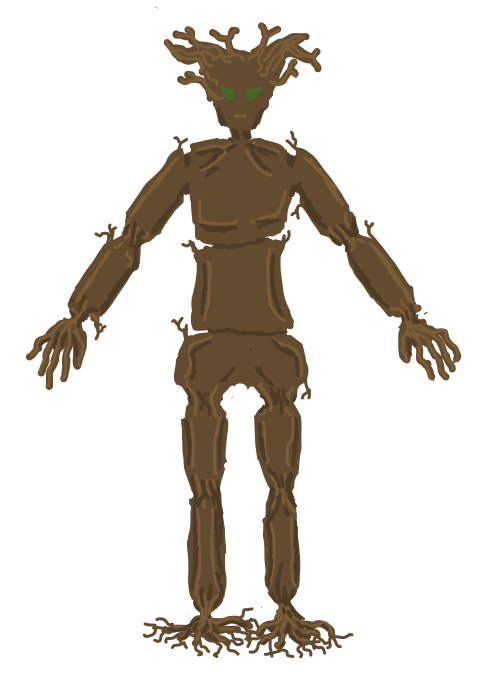 The Codews are the most populous species of Ews. They are fully intelligent, living beings with skin like bark. In Ews societies, they are the working folk. They are the industry, the army, and citizens of Ews towns. Codews are full individuals.
Despite their tree-like appearance, they are just as agile as an average muz. Softer, stretchier parts of their wood-like skin exist underneath the hard surface that allow them to move their limbs like any other. Muscle-like structures are present beneath the surface allowing for perfectly normal movement.
Their mouths are for communication and respiration only, the Codews get their sustenance from Hidol. They usually draw the energy from the Torfol of trees in their Ews network and can do so with relatively little focus. They can also draw their sustenance from certain non-floral forests such as those in Dithas or Cronar, although they do this with less efficiency. When they take energy, they enter an almost meditative state.
Drawing energy from Ews-inhabited forests is significantly faster and can often be done passively, while non-ews forests require a short sit-down. This is largely because the trees of an Ews-inhabited forest are cultivated in a specific way by them and other Ews. If they are completely isolated from any plant-life they can draw energy from, the Codews usually draw it from their own Torfol. The reliability of this method depends on an individual’s own Torfol size, where the usual unpractised Codews won’t be able to sustain themselves from their own Torfol for very long (1-2 days). Codews who rely on synthesis without fauna likely won’t be able to perform Hidist activities that rely on the usage of their own hidol. Codews do have the possibility to draw energy from nearby animal torfol, but in order to do this both the codews and the animal have to remain somewhat still.
Most Codews live in a village around an Ysgews, but villages of Codews without Ysgews exist and are called Unbound Villages. Ysgews play an important role in Ews village cultivation and leadership, so unbound Codews villages often don’t have societal structures formed with other Ews villages. The Codews aren’t tied to a village, like any person they are capable of getting up and going somewhere else.
Lifecycle
The Codews lifecycle begins when a Codews decides they would like to raise a child. Like Muz or Dos children, raising them can be a fulfilling experience and often gives an individual a sense of duty. Codews, like any other person, can choose to raise a child alone, in pairs, or with any number of other individuals. Usually in villages children are raised by the entire village and are often given a ward who will look out for them and provide the majority of guidance.
Codews are born from a seed-like egg. This egg is produced by all Ews (hence species). Most Ews subspecies are only capable of producing their own subspecies, the most notable exception being the Ysgews who are capable of producing any subspecies. The egg is often placed in dirt near fauna and left to grow on its own. Genetic information such as alleles are exchanged between eggs planted near each other.
The first phase of growth has most of the child grow underground with nothing but the two horn-like branches and the top of the head poking out from the ground. The next phase has the child out of the ground. At this stage, the codews can walk and think like a four-year-old child muz. The child can get out of the ground itself, but this often takes more time than necessary. The child is often pulled from the ground before this time as to start the learning process early. The following stage is a regular stage of growth and maturing until adulthood. The phase in the ground often lasts 2 years, and the phase of growth and learning like any other person often lasts 20 years.
Codews often live about a hundred years, but are capable of reaching 200 years of age so long as they receive proper care from their society.


 CC BY-NC-SA 4.0