Sosophax
The Sosophax are a subspecies of Phax and are by far the most common. They are the species of Phax that most commonly inhabit Kusao’s river valleys. They are sociable, and they have many of the natural offensive and defensive tools such as chitin armour as skin, scorpion claws, and a poison tail.
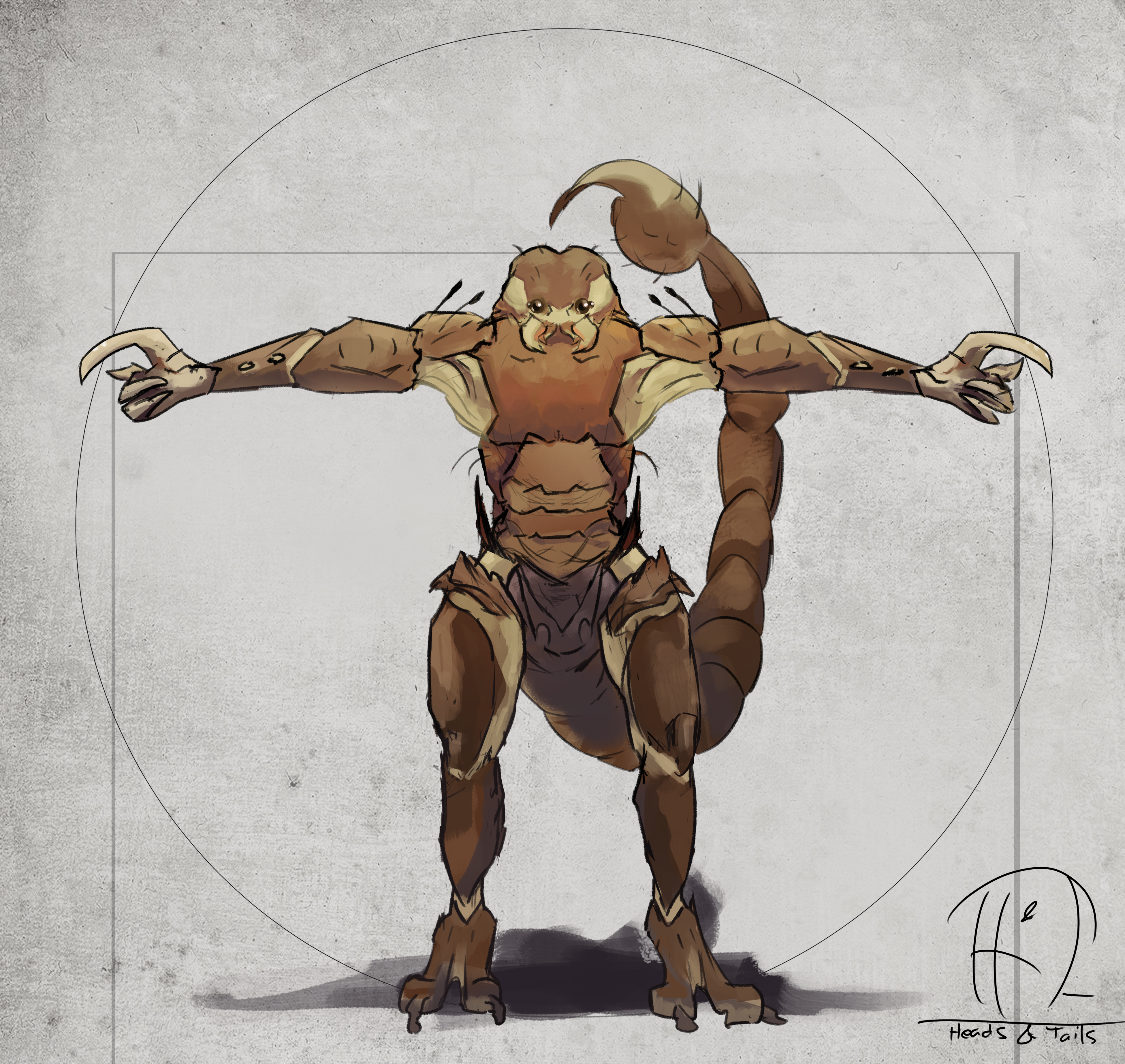
Detailed physiological description
I needed to very carefully describe how the Phax look to get the commission done for the image above. For this, I wrote a lengthy document describing exactly how to change a regular ol scorpion to get the Sosophax. Here it is:
To describe the ‘base phax’, let’s take the body of a good scorpion so that we can transform it from there. Take this image:

Take note of several of the labelled body parts, especially the main body parts, ending in the words “soma”. Although internals do not affect external appearance as much, it might still be important to note where exactly they are in order to get some ideal of how the body works as a whole.
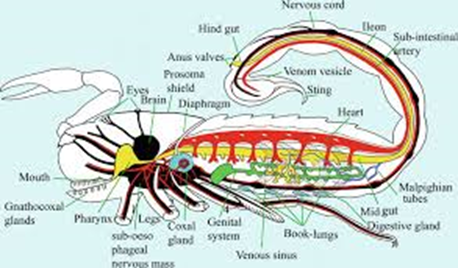
This is the image of scorpion internals I shall be basing the Phax from. To fit a more ‘realistic’ concept, I will be replacing several organs and body structures to better suit a larger, bipedal creature.
The first transformation I will describe is that of the head. First, in the reference picture the head, or the ‘prosoma’ is part of the body, and does not have much freedom to move, especially if the end goal is to have this creature standing upright. Instead of the prosoma being the head, there will be another head on top of that piece, so that the head would be pointing forwards if the scorpion were already standing upright. The connection between the head and the body will be somewhat hidden, but it is crucial that the Phax can turn their heads at least as much as humans can. Instead of the prosoma body part being the head of the creature, it feels intuitive that it would act as some form of chest, which will be the body part holding the brain. I will expand on the internals of this later, but for now what used to be the prosoma is now more of a chest.
Next, the warping of the arms and legs. If we imagined the creature limbless for the description, the arms would be in almost the same place as where the claws join the body, and it feels intuitive to keep them looking fairly similar. The hands themselves, however, must be grabbier in order to allow the Sosophax higher society. To get a proper idea of the hands, first imagine the claw of a scorpion. Then, the larger part of the claw will be downsized and become bendy so that it could be used more like an opposable thumb. On the other side, the claw will turn into 2 different fingers that oppose the thumb and otherwise look similar to human fingers. The opposable thumb will be in almost parallel opposition to these fingers, so the Sosophax cannot lay their hands out flat in the same way that we do. Then, for the sake of eccentricity, there will be a third tiny finger on the upper part of the hand, perpendicular to the rest of the hand. This is the hand structure of the Phax, all covered in chitin except from the joints where parts must move.
Moving downwards from the chest, it is intuitive to think of the mesosoma as a lower body, making it shorter if it feels intuitive to do so. The two main legs will be positioned in the centre of this bodypart. In reference to the image, the trochanter will be internalised allowing the femur and tibia parts of the leg correspond as they are on a human. These parts will often be bent as the Phax stand. The foot will be similar to how it is on a regular scorpion, with the claw being the part most often in contact with the ground and the tarsus being the body of the foot, usually off the ground as if they are constantly standing on their toes. Their feet will be 2 claws, one slightly larger than the other.
The parts of the mesosoma below the legs will merge into the tail, which is large enough to loop around the body and come back over the head. This tail will be mostly identical to that of the original scorpion’s tail, although the stinger might be different.
To develop the head, the median eyes will be removed, and the lateral eyes should be larger and with more mammalian eye parts with transparent eyelids. Their pupils do not dilate, as they are all black. There are systems within the eye to stop damage to the eye parts.
The Phax still have chitin on their outer bodies. This chitin enforces the structure of their bodies as well as protects them from harm. On joints, the chitin gives way to more fleshy parts of their skin similar to the joints of the regular scorpion.
Although less important, the Phax have different internal structures to humans and regular scorpions. Firstly, they have some semblance of a skeleton, although this skeleton is made out of chitin and therefore does not produce blood. There is a separate organ for this. The Phax have a proper circulatory system where the heart is located in the lower body and pumps blood all around. The blood is a haemolymph-like liquid that has antibacterial properties, provided by another organ. There are 2 organs that produce blood and they are located between the heart and the brain. The brain itself is located in the chest. The chest also holds 6 independent lungs all operated by a single diaphragm that utilises the softer shell on their chest to breathe. Their brain is separated into 2 parts, but instead of a left side and a right side, the Phax has an upper and a lower lobe. The upper lobe of the ganglion is inflated. It processes the information received by senses, and is responsible for the Phax’s thought. The lower lobe is responsible for the subconscious and the management of bodily functions.
In terms of colour, the Phax environment is a canyon desert, much like the landscape of Afghanistan or Utah. Their skin is usually pale sand-like for camouflage, or black and tan.
With all of this in mind, your image of the Phax should be somewhat similar to the image that I hold. It might be important to note that the Phax did not evolve from scorpions in the lore, they merely came to be, and therefore their similar features are not there because they are there on a scorpion, they are there for the same reasons a scorpion’s parts are there.


 CC BY-NC-SA 4.0