Western Neble Imperia

The Western Neble Imperia, or WNI, is a federation of four smaller militaristic imperia. These are Ech, Xynt, Wanidir, and Wyn. The word “western” in the name of the nation is largely outdated. In the past, WNI was a collection of strictly western imperia, but nowadays these are the only imperia in Neble that do still generally adhere to the western part of the region. The only other imperium on the two continents is the Roughwalk Imperium.
The Structure of an Imperium
The socio-economic structure of the Imperium is incredibly unique, strangely democratic, and highly militaristic. It revolves around a number of blatantly defined social classes.
Social Classes
Western Neble Imperiums have four distinct social classes defined by and enforced in the nation. These are the lowfolk, citizen, soldier, and officer. This also seemingly divides the population into military folk and common folk.
Citizen
The imperium is centred around the citizen. They are a privileged and wealthy class who are usually successful artisans, guild leaders, merchants, and industrialists. These citizens are required to contribute to the defence and management of the state through personal command of a military unit.
Citizens have voting rights, the ability to run for government office positions, and the expectation to lead a military division of their own. They are expected to fund, train, and lead military forces upkept by their own wealth.
To become a citizen, an individual has to fund and maintain their own militia. This militia is part of the general public army, which serves for the defence of WNI. Many citizens are veteran officers, or otherwise wealthy businesspeople.
Lowfolk
A lowperson is someone who holds no political power. They cannot vote and they have no say in the military. Lowfolk are almost always workers and peasants working for citizens. Despite the clear social division, lowfolk are capable of some form of social mobility, by joining the soldiery or otherwise managing to amass enough wealth to found their own militia and become a Citizen.
Soldier
A soldier is part of WNI’s military system. They serve either directly under a citizen, or under a trusted delegate or officer. Although soldiers are a distinct social class, they might find themselves performing similar economic activities than lowfolk in their part time. Soldiers are granted limited voting rights, but may still not run for positions of power.
Officer
An officer is a soldier chosen by a citizen to command their military force. Militias commanded by officers are usually frontline armymen, allowing the otherwise interior citizen to fund the army at WNI’s offensive and defensive borders. Officers are allowed to vote in all aspects of the imperium, and may run for positions on the army council.
Imperial Council
Imperiums have their own imperial council, which is an elected selection of citizens that legislate laws, oversee taxation, and manage internal developmental matters such as commerce, agriculture, and military development.
The chancellor of each council is an elected member of the council granted special executive power and marshal command of frontline military units. Usually, marshal command is delegated to a dedicated individual who is seen to serve the chancellor. This military command is answerable to the imperial council.
Military Council
Military matters are discussed separately to civic ones in military councils. Commanders of military units (either citizens or officers) are allowed to run for military council. The military council usually discusses matters of defence and offence, coordinating the otherwise disconnected military units. The actual action of the collective military is decided by the marshal, who is either the chancellor of the imperial council or a delegated officer.
The Neble Cultural Identity
The cultural identities of Neble are crucial in maintaining solid economic and military cooperation. General ideas in Neble-based cultures are focussed on the importance of might and strength, which is exactly what lead to the formation of the Imperium and the autocratic military organisation of the Empire of Plaen. These cultural identities help unify Neble cultures as a whole, and keep structures like the Imperia in place.
Reciprocity
The System of Reciprocity is an idea shared among Imperia that the work-owner relationship cannot be a one-way system of oppression and slavery, but instead certain reciprocations need to be made to workers to ensure their efficiency and solidify the stability of society. These reciprocations are usually an insurance to quality healthcare, education, and economic rights. Reciprocity also applies to the soldiery, but in a slightly different way.
Part of what makes the Imperia different is their government institutions of Reciprocity. These institutions are often ruled and managed by a collaboration of lowfolk and citizens, and enforce labour rights and other reciprocities, as well as host a number of reciprocal events such as festivals.
Generational Disconnect
In Neble culture, generational disconnect refers to the phenomenon of wealth not being passed down through generations. Generally speaking, if a father or mother has amassed lots of wealth, when that person dies the wealth in their name generally gets distributed to a number of institutions. First, any liquid assets or hard money they have is often taken by debtors or the taxation system. Any private property (such as factories or farms) they owned is handled differently, using the Disconnect Trust.
Public Trust
The Public Trust is an institute of an Imperium’s government created by the cultural idea of generational disconnect. The Public Trust temporarily holds a citizen’s private property when they die, and then these properties partake in a special process where they are bought up. The money the Public Trust makes in these bids goes into taxation, and given the high frequency these bids can sometimes be, it means that actual citizen taxation can be kept on the low.
Discounts are handled based on ordinality, and the exact value of discounts depends on the type of property, the will of the deceased citizen, and local tradition. Generally, there are three orders of discount. Who these orders of discounts are given to is explained in the steps.
Step 1: The Public Trust assumes temporary ownership
Upon the death of a citizen, the Public Trust takes ownership of the citizen’s private properties. These properties are split up into reasonable divisions, so that factories that were legally part of one property are divided into two properties. The citizen’s militia is dissolved, but it is understood that the soldiery of that militia will either buy up properties for themselves or be re-hired by the owners of the new properties. The soldiery and lowfolk working for the citizen are paid low living wages until the end of the process. The Public Trust evaluates the value of the assets, and then they are put up for step 2.
Step 2: Ceremonial Duels
As part of a long cultural tradition, contests of dominance in the form of ceremonial duels are performed by the citizen’s subordinates and family members. Victors of these duels are given first-order discounted prices and exclusive access to bid on and purchase certain properties before they are made available to the general public or higher-bidding citizens. The types of duels that occur depends on local traditions and the will of the deceased citizen. They range from single combat duels, group challenges, or strategic and intellectual contests.
Step 3: Bidding for non-duelists
After duels have been settled, the remaining soldiery and lowfolk subordinates of the citizen, and their family, are given second-order discounts and are allowed to bid on or purchase properties.
Step 4: Open Market Sale
Any properties not yet purchased during previous bidding and purchase phases are placed on the open market, where:
- existing citizens can purchase the properties at normal valuation
- non-citizens (such as lowfolk or soldiers under other citizens) are eligible for third-order discounts
Militia reformation and Re-employment
Once property sales are completed, the new owners are expected to re-hire the deceased citizen’s subordinates. This includes adding the former soldiery to their own militia, if the property was purchased by a pre-existing citizen, or forming a new militia out of the former soldiery if the property was purchased by a previously non-citizen. The workers of certain properties are also usually re-hired. This happens with far less exceptions than the soldiery, as generally speaking these workers know best how to operate the machinery of the property better than new-hires would. Often, however, some lowborn or soldiers are made unemployed and replaced by family members of the new owner. This practice is frowned upon.
The Structure of the Federated Imperia
The Western Neble Imperia is a federation of the four Neble Imperia. As an organisation, it mainly consists of a high council and the federal army council
Federal Imperial Council
The Federal Council is a council of four sections - one for each imperia. The council is relatively small (8 members for each imperia), and is made of elected citizens from each of the imperia. Regularly, one of the members of the Federal Council is made into High Chancellor and their council position is left empty. The High Chancellor serves the same role as the chancellor of the imperial Council - to lead or delegate command of the Federal army.
Federal Army Council
The federal army Council mirrors the federal imperial council, with four sections and 8 members per imperia, elected from officers or commanding citizens of imperia. Much like the military councils of the imperia, it serves more as an advisory board to the High Marshal, the commander of the federal army. The high marshal is either the high chancellor themselves, or a delegated officer.
Federal Court
To facilitate collaboration and cooperation between the imperia, a hereditary federal court was founded and is still operational. Magistrates are the overseers of the court who hear and judge federal cases. Magistrate is a hereditary position, and the magistrate families are generally seen to have no political bias.
Role of WNI
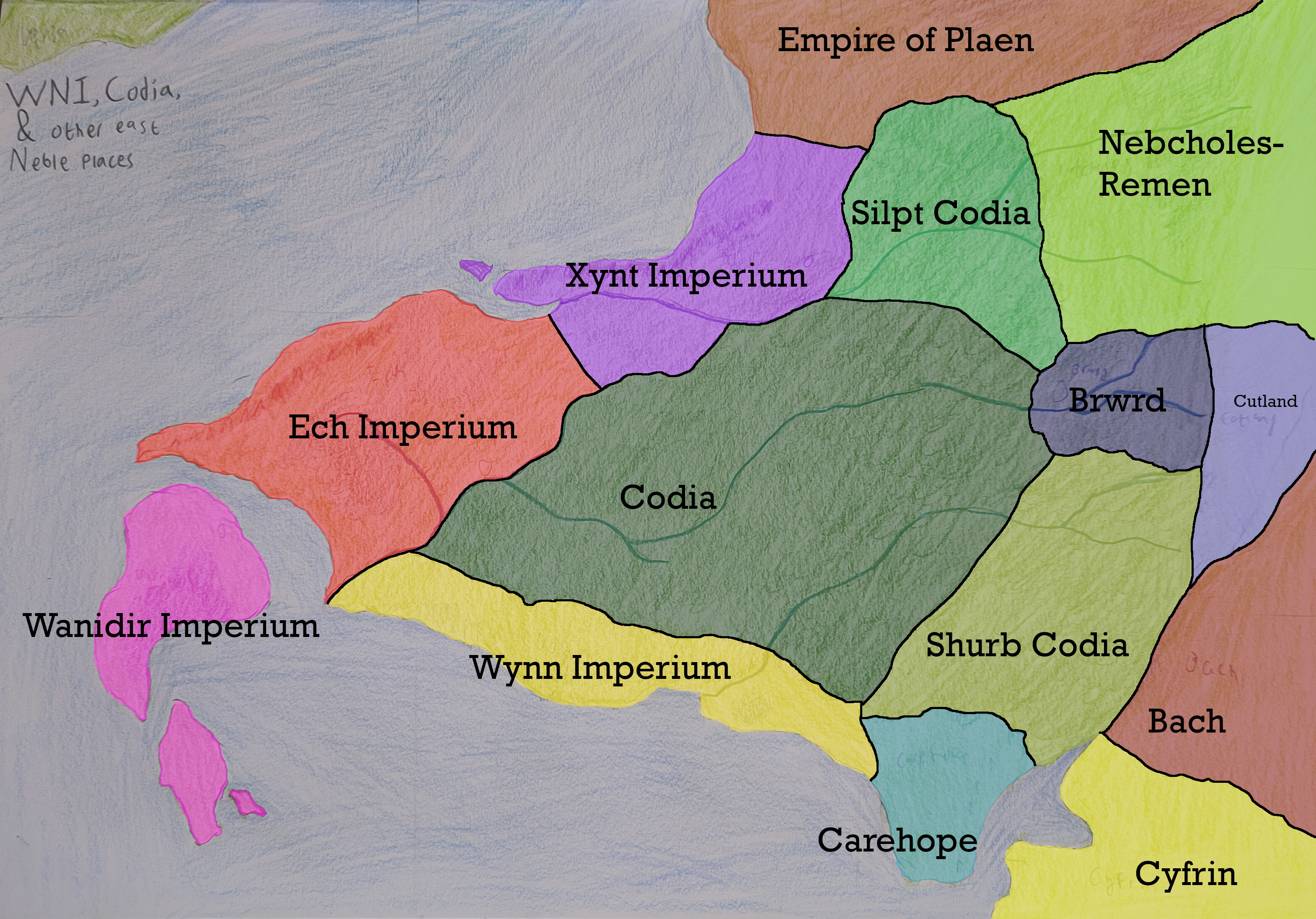
The WNI’s governance is predicated on the idea that military strength and economic success is inseparable. This has historical roots in the Neble culture’s historical conflicts with Codia, which has forced any industrialising citizen to arm themselves and fight the forest.
Although the war with Codia has its times of rest and swell, Citizen’s wealth is often derived from industries that directly support the war effort. Weapon-making, agriculture, shipbuilding, and other vital goods for the war economy.
Many guilds often operate as quasi-military orgnaisations, with their leaders holding roles as economic leaders who coordinate artisans who may themselves be citizens, and roles of military significance as they can leverage their positions to vastly increase the likelihood they are elected onto military councils, or even as chancellor or marshal delegate.
Specialisations of the Imperia
Xynt
Xynt is an imperium known for its industrial strength. Sharing a long border with Codia, citizens who organise productions have very clear and direct stakes in the war and the imperium as a whole.
Ech
Ech is a land-based imperium known for cavalry traditions. Its citizens are usually large landowners who oversee peasantry and feed the war effort.
Wanidir
Wanidir, being in control of a large island, is completely disconnected from Codia. It has amassed naval traditions, providing and organising a large portion of WNI’s navy, with Xynt organising the remainder and the other two imperia not having any stakes in the navy.
Wyn
The most militarised imperium with a lot of very small but highly trained militia.
Modern Events
Reformism
The system of imperia does work but it was given to a culture of war. Ever since the western imperia united, the northern and eastern imperia fell to autocracy or federalism. These elements are present in WNI, trying to dismantle it’s existing social fabric.
War with Codia
Codia is in an active and long lasting conflict against its neighbours, including the Western Neble Imperia. The war has entered a bit of a lul, but fighting does often occur as is somewhat required under the imperia organisation.
Treeless Buffer
The treeless buffer is a large stretch of land without any forestry. This buffer zone is where the vast majority of fighting occurs, with Neble war parties being sent out to destroy new saplings and to cut back the forestry, and Codia sending forces to cultivate and protect saplings and protect against their own trees being demolished.
Peace Negotiation
As of recently there are major discussions of peace between the Western Neble Imperia and Codia. The largest proponent being Codia groups who are content with the borders and WNI capitalists who want to focus on internal land development rather than aggressive expansion. The largest opponents are Codia factions wanting reparation for historic land lost and the entirety of WNI’s military being based around constant conflict.


 CC BY-NC-SA 4.0