Ereso
Ereso is a highly varied region. It’s very warm, fertile, and industrious. It’s core is dominated by well managed farmland and forestry and large towns and cities. It also has many wild areas that are barely populated, preserved and celebrated for their natural beauty. Fields shine a vibrant green. Cities are built from stone and colourfully painted. Rural towns are often bound in timber and mud brick.
Geography and Climate
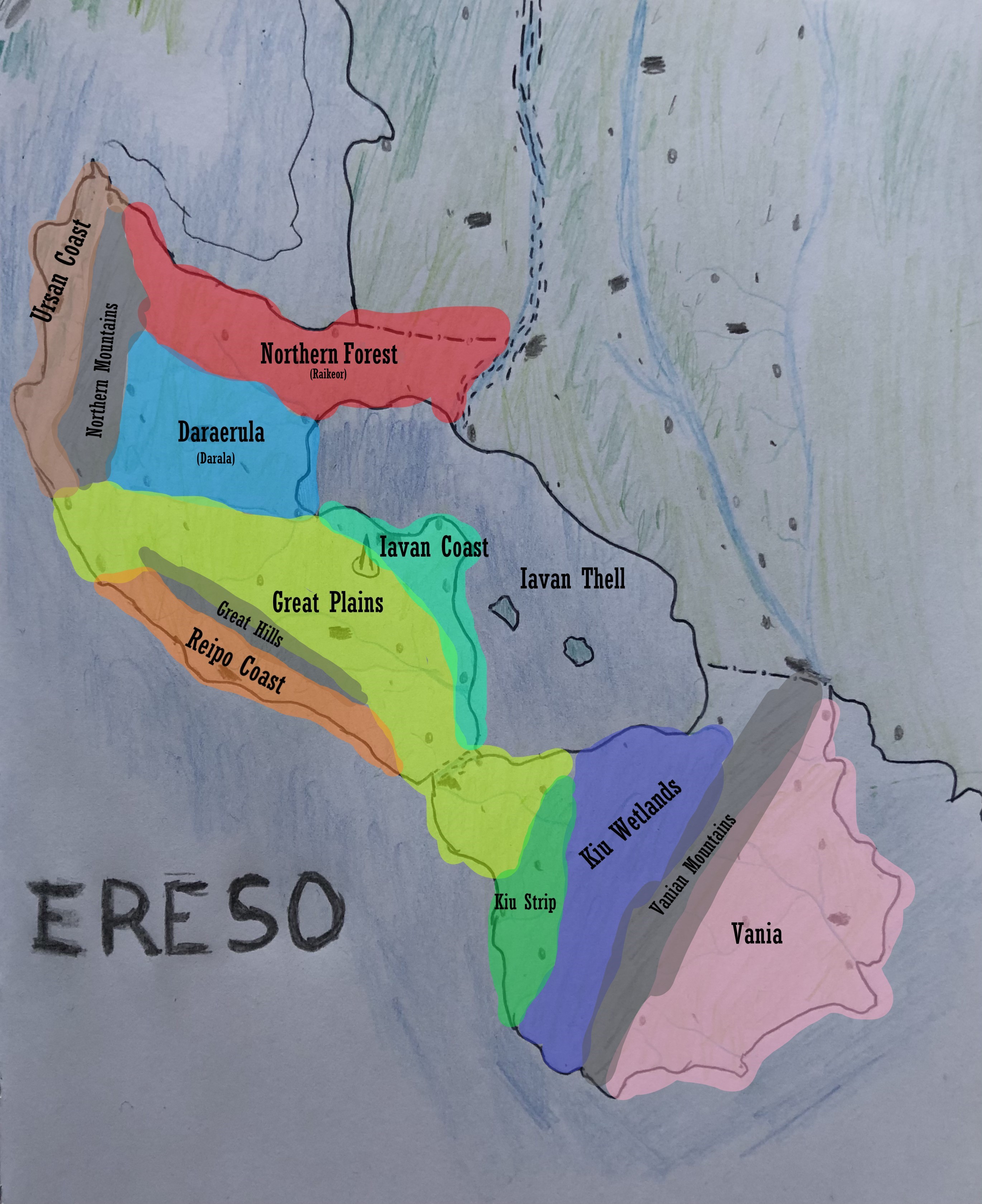
Ereso is a highly varied region, it’s climate best split into seven distinct regions. Ereso is generally subtropical evergreen.
Ereso, like Shildo as a whole, experiences a wet season and a dry season. Ereso’s seasons are better described as a wet season and a very wet season, as the region receives comfortable rainfall throughout the year. Most of Ereso is well shielded from weather, behind the Vanian and Northern mountains and the great hills. The un-shielded areas have frequent storms.
The Great Plains
The Eresonian great plains is the most dominant geographic feature. It is primarily low-rolling hills varying about 100m from peak to base, with the region as a whole spanning heights from the coast to around 300m. Some places have small hill systems that vary to peaks of 500-680m above sea level.
The great plains also covers the Kiu strip, Iavan Coast, Reipo Coast, and Daraerula. These regions are not geographically distinct, but are culturally distinct.
The region is in-between two aquatic features: The lake of Iavan Thell and the Cadole ocean. These two coastal regions vary in their fishing culture and available foods, as well as shipping culture.
Being highly developed, there are very few natural areas left. Those that do exist are intentionally preserved old growths and national parks, some having previously been designated “royal forestry”. Old growth trees are subtropical oaks, magnolia, and camphor.
Industrially used trees are primarily pines, grown for pulp and timber.
Agriculture is highly productive, potentially the most productive in all Shildo. Farmers combine ancient lime fertilisation techniques, well-tested field layouts, and modern crop rotations.
Staple crops are flint corn, rice, and sweet potatoes. Additional crops are chickpea, tea, and sugarcane. Plantations often grow citrus, dragon-fruits kiwi fruit, other suitable fruits, and coffee.
Great Hills
The Eresonian hills, also known as the great hills, are a large chain of mountains that at their peak reach about 750m above sea level. They are highly eroded, and uniquely form many high-altitude lakes which have unique ecology. They are sparsely populated with small towns which primarily house Ereso’s elite.
Low-lying regions plant tiered and wet rice.
Ursan Coast
The Ursan coast is a significantly wetter rainforest area in Ereso. It is about half developed.
Raikeor
Raikeor is the smallest of two remaining Ews forests on Barogate. It was not deforested and instead deemed a refuge of the Ews and an important ally to the Eresonian empires of the past. Good will remains between the people of northern Ereso and the Ews of Raikeor. A treaty stands between Raikeor and the governments of Ereso that recognise Raikeor’s status within the government.
The forest is dominated by dense and wild subtropical oaks. Sanctioned roads run from north to south, bisecting the few sanctioned non-Ews settlements.
Kiu Wetlands
The Kiu wetlands sit between 7m and -3m. Water seeps out from Iavan Thell and across this region. It is largely depopulated, although person-made banks and mounds across the region suggest that this was not always the case. It is dominated by wild grasses that extend several metres upwards. The subtle current keeps the region freshwater, however nearer to the coast the tides often dictate salinity.
Vania
The Vanian region is noticeably dryer than the great plains, although it is still wet compared to non-Eresonian regions. It has a unique agriculture.
Mountainous regions
Ereso has two main mountainous regions.
The Northern Mountains are tall and spiky. It has a unique taper, with it’s peak mountian, Rouval, near its centre that reaches to 3400m. Mountain peaks decrease rapidly downwards, with the average being around 1400m. The northern mountains are mostly un-populated, with a few valleys either side housing agriculture.
The Vanian mountains are a sharp gash across the south of the region, with one long, near-continuous peak travelling around to 2700m above sea level. It has significantly more populated valleys than the northern mountains and is host to a significant animal husbandry culture.
The Silent Islands
The two islands in lake Iavan Thell are considered part of the region of Ereso. They are completely uninhabited due to long-standing cultural beliefs surrounding the islands. The silent islands are notably wetter than the usual Eresonian climate.
Culture & Demography
The dominant cultures of Ereso are all of Llofil Shildoan descent.
The most demographically dominant by far is Sapyat. It is the majority culture of the Sapyat plains. Other cultures are regionally dominant. The Kiyvan culture is dominant across the south of ereso, namely the Vania region and the Kiu strip. The Vevran culture is common across the north of Ereso, namely Daraerula and the non-Ews settlements of Raikeor. The two other present cultures are Ursan in the north-western rainforest, and Reipo across the western coast.
The major cultures have a number of local variation.
The primary language of Ereso (called Eresonian, which is also the demonym of the region and the citizens of Eresonia) is historically the language of the Sapyats spoken by the courts of historic region-spanning empires originating in the Great Plains. Each culture has its own mutually intelligible variant of the language, with Ursan and Kiyvan having large lexical differences.
Fauna
Character Animal: Eresonian Panther
Ereso’s character animal is the Panther. There are specific breeds cat, the Iavan Cat, which is essentially just a tiny domesticated panther. A particularly striking emblem of Ereso is the black panther on a white brick background. They aren’t really around the developed regions anymore. Although they are present in regions like the Iavan Coast and the Great Plains, they have been delegated to be more common in less developed regions and Daraerula.
Name origin
Ereso is inspired by the lands of Kaerle and Nixiana on DeMoch. Daklyn spent a good amount of his journey in these areas. The migratory Kithral Kaer originally landed in this area and named the place “first land” which untranslated is “Sheres Do”. Daklyn shortened and ouranxised this into Ereso.