- Barogate
- Ereso
- Terlaye
- Ralean
- Sarel
- Kyeron
- Gazi Lale Darie
- Gordolmonre
- The Heabe
- Dithas
- Vugaix
- Duela
- Kyenel
- Kusao
- Cronar
- Ichmenre
- Llyhai
Vania
Vania is a subregion of Ereso. It takes up half of the Kiyvan peninsula, and includes the Mountains of Vania.
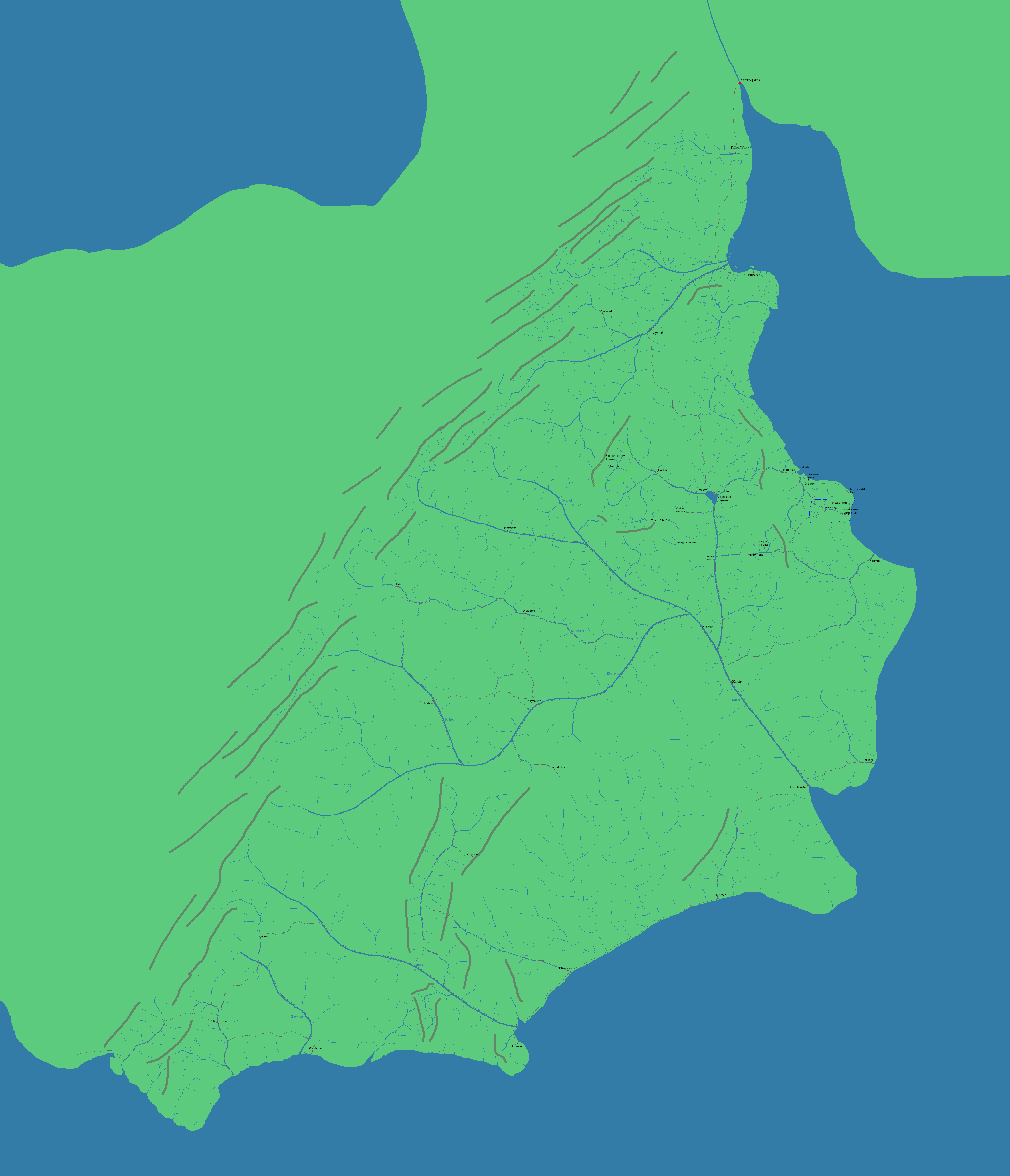
The above image shows all of the towns and villages in Vania as well as its only city and capital, Karsir.
Relevance to Ereso
Vania is incredibly geographically disconnected from the rest of Ereso. First, there are the Vanian mountains, which on average are the tallest mountains in Ereso with a consistently tall ridge like a wall cutting the peninsula from Korunten to Fallen White. The mountains are a part of the Republic of Vania, as the official border is between the swamp and the dry mountain land.
This swamp is the second natural barrier. A large freshwater wetland dominated by tall subtropical grasses, bugs, creatures, and mud. There are a few man-made ridges that try to make a dry land bridge over the swamp, but these do not last long without maintenance so the most persistent are in the south-west, from Byseten to the side of the Vanian mountains adjacent to Aone.
Trade rarely travels through the swamp, which stretches from Iavan Thell to the sea. What trade does happen is either foot-only or cleverly prepared semi-aquatic carts. Trade is significantly more comfortable boating along the coast from one of Vania’s many ports to Port Hiagero, Narsyrdel, ports farther north, or ports on the lake. Trade by sea also offers easy access to southern Ralean or Neble, or even the entirety of Terlaye up the navigable Nater’s River or Rullan river. Trade with Terlaye by land exclusively goes from Fallen White to Nater’s End.
Culturally, Vania is majority Kiyvan, which is a chiefly Eresonian culture. It is part of the 3 majority cultures of Ereso. The other two majority cultures are the Sapyat culture of the centre and the Vevran culture of the north, with two “minority” cultures being present on the west coast - Reipo and Ursan. The Kiyvan culture, like many cultures, established itself in the short-lived Eresonian medieval period. The culture permiates communities living in the swampland as well as a portion of dry land known as the “Kiu Strip” which sits between the swamp and the central plain land.
Then, even though Vania itself is geographically disconnected from Ereso, the culture of the land spreads into the rest of Ereso. Also, the Vanian area has been a consistent part of Ereso’s empires and has always been more politically similar to other Eresonian subregions than Terlayan or Ralean subregions.
Culture
Vania is dominated by the Kiyvan culture, which is one of the three major cultures present in Ereso. This culture, like all others, is itself a concatenation of similar cultures present across all of Vania. The “sub-cultures” are:
- Iboan, a culture dominant in the Iboa region that values tranquility.
- Karsirian, the culture for the downstream parts of the River Karel, spanning roughly from Anesir to Port Kardel. They value hard work and industriousness.
- Karelsirian / Oenes, a culture dominant in upstream Karel and its tributary Oenes. It’s similar to Karsirian.
- Eby, a culture with a strong self-identity present across and around the Ebyjevin river and its tributaries. They value independence.
- Asheshtan, a culture dominant in the Asheshty region. The culture is influenced by their rural lifestyle.
- Aoneian, a culture with historical inspirations from Mothdao, present primarily in the Aone region and across the mountainous border. They value their uniqueness and Mothdaoan heritage.
- Elinare, a culture dominant across the Elinare river and in the Cyaleta region. They value community.
- Vanian Shildoan, a culture dominant in the Fallen White region and around the town Shirein. They often value trade and diversity.
- Kiyvan Wetland, the primary culture of the Kiu Wetlands, which is in Eresonia.
Locations
Iboan Lake
Iboan Lake has received a special amount of detail due to it’s feature in the simulation game demo. The detailed map features the most important places of interest in the region.
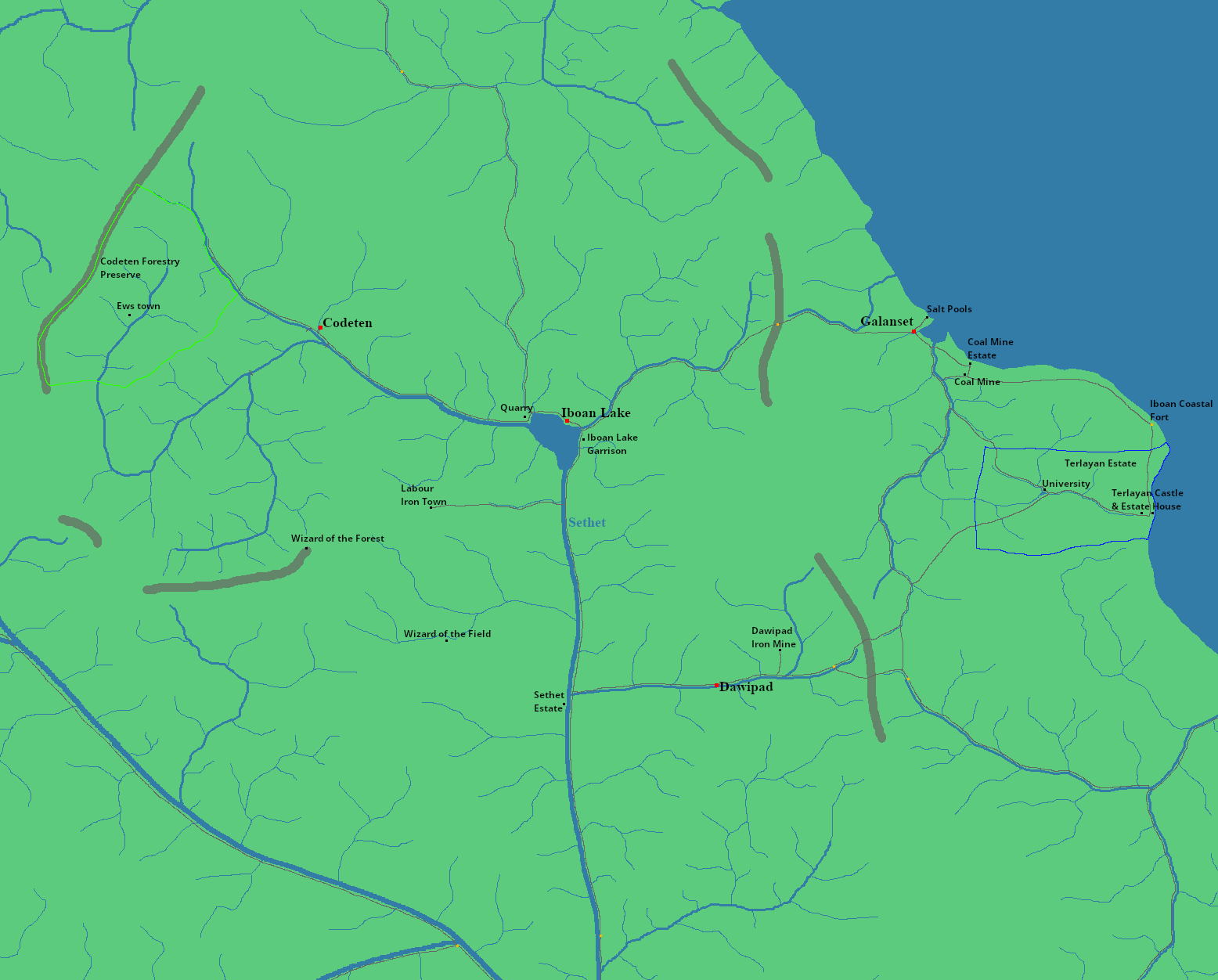
The most prominent geographical features are the Sethet river, the Sothech hills, and the West Vanian Hills. The Sothech hills are in the west, forming an almost bowl-like area in which many tributaries feed the Sethet river. The Sethet river then flows east into the titular Iboan Lake before darting nearly perfectly south to join the river Karel. The West Vanian hills reach from the northmost part of the region’s coast south in an uneven fashion before flattening out and becoming the plateau in the Karsir region.
The following discussion will mention the political alignment of the region as of the time at the start of the simulation.
The town of Iboan Lake is a quiet and quaint town situated on the Iboan Lake, which sits in the centre of the region. It has all of the facilities one would expect from a town. In its labour-dominated west, there is a popular and historic theatre.
Iboan Lake is the perfect microcosm of the wider economic and political struggles of Vania. The region is currently characterised by the struggle between the two major political parties: Labour and the Estateers. These forces struggle for power among several smaller factions such as the political party The Guards, independents often represented by the Free Market party, and the government.
The region, and the town itself, is split between these two forces. While the town is majority labour-controlled workplaces, the Estateers maintain a competitive set of for-profit businesses in the north-east of the town. The quarry not far west of the town is a Labour stronghold with a large and organised workforce.
To the west of the town, there is a large limestone quarry that acts as the town’s major Labour-aligned force.
Iboan Lake is the capital of the region, and due to recent political turmoil the guards have increased their presence in the region, boosting how many guards are stationed at the Iboan Lake garrison which almost acts as its own town sitting just south of Iboan Lake.
The Estateers also own a large portion of the farmland to the north-west of Iboan Lake.
Codeten & Sothech Basin
Codeten is a village west of Iboan Lake, up the Sethet river. It facilitates the large forestry industry in the basin formed by the Sothech hills. The workplaces in the town are majority Estateer, although there is still a large Labour workforce. There is a large culture of artisan wood workmanship, with many independent artisans selling their products to Estateer tradespeople.
In the north-west of the basin, there is the Codeten forestry preserve. In the centre of this preserve, there is an Ews town. These Ews, among others like them, are a relic of the Eresonain Wire network that was disassembled in 2674 following the constitutional purge. The Ysgews of this village is a child of the Ysgews that acted as Codeten’s wire correspondant. Most Eresonian Ysgews were displaced to Raikeor, with many Vanian Ews relocating to Ralean’s Eswin.
In the early revolutionary period in Vania, the Ews were used by revolutionaries to help dismantle local Private Conqueror strongholds. In return, they were granted the “Codeten Forestry Preserve”, a large portion of untouched forest that will not be forested. In the modern day, the history and presence of the Ews in the area is known by local officials and historians, but their presence is kept on the down-low.
Galanset & the Iboan Coast
Galanset is a large port village on the Iboan coast, east and slightly north of Iboan Lake. It is a Labour stronghold with almost all workplaces dominated by Labour. Galanset has a huge folk culture revolving around the docks and the port industry.
To the north-east is a small Estateer salt industry. It’s output is low, but it produces enough to locally compete with imported salt from upper Cyaleta. To the south-east there is a small Estateer coal mine working on a very small deposit of coal, which struggles to compete with Labour-produced Cyaleta coal.
There are two fortifications economically attached to Galanset. One is halfway on the road to Iboan Lake. It was established during the first Eresonain Empire with the goal of protecting Galanset and Ibaon Lake in the cast of a coastal invasion by Neble or Ralean nations. Similarly, there is a fortification from a later time in the same empire positioned on the coast itself.
Dawipad
Dawipad is a mostly independent farming village, providing the majority of the region’s food. Transportation of the farm goods are usually independently transported by caravanserais and direct methods. The businesses in Dawipad are mostly Labour-lead.
There is a small Estateer iron mine a small distance east of Dawipad. This iron mine struggle with the huge Labour-controlled iron mine in the region, but gets along by attracting political business from the Estateer-aligned smithies and businesses. Most of its produce ends up in use by the Terlayan Estate.
Terlayan Estate
Durign the Second Eresonain Empire, there was a short period of time when this particular section of Vania was controlled by a Terlayan lord. The lord integrated into the Pri-Coners and managed to permanently establish their dynasty in the area. During Terlaye’s late medieval period, this dynasty collapsed or otherwise fell to its rivals. The members of the dynasty ruling over this part of Vania held on until the revolution, where they non-violently complied and integrated with early Councilist Vania.
During Vania’s Councilist period, the land formerly controlled by the Terlayan family was well kept by them and their local council of workers. It became an appreciated local oddity; a piece of a foreign culture close enough to visit. The family kept their Terlayan heritage close and built a small university town inspired by Terlayan architecture. They also kept the castle built by their ancestors in repair.
However, with modern Vanian political developments, the Terlayan family has claimed its formerly owned land once more. With Estateer legal support, they now legally own the land as an estate, including its farms, the university and its village, the castle, and their newly built coastal estate house. They have cooperated closely with Iboan Estateers to secure their power, while managing to keep local reputation fairly high with low university fees and little to no taxes.
The land controlled by this family as an estate is the third largest “estate” in Vania, behind a larger Ebysarsirian estate and the estates of the Versidillen. It’s university is the only private education in Iboan Lake and is one of four universities across Vania, the others being in Karsir, Ebysarsir, and Aone. They offer classes and courses on mathematics, classical studies, and the natural sciences.
The castle in the estate is a relatively small construction that acts primarily as a tourist destination, as the family that owns it now lives in the modern coastal estate. The Terlayan family maintain the rights to use the castle for practical purposes should conflict come to their estate.
Terlayan Scrip
This is very well leaving the region and entering the political and economic, but I’m yet to figure out a better organisation.
The Terlayan estateers have their own form of scrip. The Estate’s car coins, or “crabs” as they are alternatively called, mirror the old Terlayan coinage before the absorption of the kingdoms into the Empire of Ralean. The estateers claim to maintain the car coins in reminiscence of their heritage, however they have functional value.
A car is worth 1.05 marks within the Estate. Of course, this usually translates to mean that stores charge 5% more on their product’s marks cost. By mandate, businesses that aren’t owned by the estate being established on estate lands must accept car.
The scrip can be used in the place of the normal Eresonian currency (Marks) in business places within the Terlayan estate. It happens that the estateers of the estate own many of these businesses.
Scrips can be purchased directly, and it is encouraged for tourists to do so as they hold a better value than marks within the estate. Many tourist-specific places that are focused on Terlayan imagery only accept car.
All workplaces within the Estate pay workers in marks. However, most workers request to be paid in car instead due to their greater value. Worker bonuses from workplaces owned by the estate also only give bonuses in car. Workers choose to get paid in car, but for their bonuses they have no option but to receive car.
The university maintains student accommodation. Much of this accommodation is “catered”. The accommodation itself does not have cooking facilities, but instead students are given a number of car to spend on food at local cafeteria. This car is “bundled” as part of the tenancy package, it is ultimately payed by the tenancy fees. These tennacies are not available without the catering fee (which is not explicitly shown in any receipt).
University bonus schemes will also exclusively pay out in car.
Outside businesses would have no need to accept car. If someone wants to get rid of their car, there is no “formal” exchange system and they would have to privately exchange them or exchange them informally with friends. Coincidentally, there is a “currency conversion tax” in the estates allowing the estate to collect some portion of returned car value.
Iron Mine Town
The Iboan Lake Iron Mine is a large iron mine and industrial are with local accommodation quite far from any of the region’s towns. The iron mine produces almost all of Iboan Lake’s iron as well as exporting some south to Karsir and other regions.
The mine serves a secondary purpose of being the primary Labour stronghold in Iboa. It is far, but not too far, from Iboan Lake, highly lucrative and defensible. It’s only road goes directly east towards a bridge across the Sethet river, but many people walk directly to the lake and take a ferry. Or, if they are going to Codeten, they will follow paths north and ferry across Sethet there.
The Academic Wizards
South-west of the lake are two rival “academic wizards” (often abbreviated to Acwiz). These wizards are powerful, independent, and important elements of the Iboan economy. They are non-political independents, only wishing to conflict with each other. They are often referred to as the “Wizard of the Forest” and the “Wizard of the Field” based on how the Wizard of the Forest is set up within a Codeten forestry and the Wizard of the Field is on a large open field amongst Iboan farms.
History
This history was written with a specific focus on the region of the town Iboan Lake, because the simulation game demonstration is set there and the area needed a deep and interesting history.
The first people to be around the Iboan Lake were the proto muz who inhabited the Vanian region. The first permanent muz settlement on the lake was established around -5500, which is somewhat normal time for a town of its stature. Before this, the lake was a popular gathering spot between tribes, who still gathered at the permanent town until the tribes dissolved into society. The town faced many flooding troubles throughout the centuries following.
The next notable event was the dawn of civilisation. Around -3150, Iboan Lake would join a faction begun by the city of Karsir. Iboan Lake would stay as a town of Karsir until about 1100, when it would begin to form its own identity. Many wealthy or retiring people would go here seeking the tranquillity of the lake. Also around this time, the town of Ebysarsir was gaining its own identity, which would eventually become the identity of all Vania, the future Kiyvan culture.
In 1200, the Dolom republic would form. Meanwhile, in southern Ereso, several factions were appearing. Hyabinia, Norania, Higaronia, Sesnolnia, Evniala, Elnarania, Karnia, Kiyvania, and Setreishnia. Kiyvania, centered around Ebysarsir, would slowly organise and assume control over Setreishnia. In 1300, Korungng would invade Evniala to begin with, slowly moving forward and conquering Elnarnia and taking much of Higaronia’s lands. This development forced the Tristate of Hyabinia, Norania, and Higaronia to form to stop Korungng’s conquering. Karnia would suffer a lot from Korungng’s attacks across the open Vanian planes. Ebysarsir and Kiyvania however remained well protected behind the Nidioy river. Kiyvania would take this oppertunity to send an ultimatum to Karnia, forcing it under Ebysarsir’s wing and joining forces with the Tristate and Sesnolnia to fight back Korungng. Kiyvania would take control of the land retaken once Korungng was pushed out, with the rest of the land being shared between the Tristate and Sesnolnia. During these events, there was a massive push to develop Kiyvania’s towns to a point where they are strong enough to provide the industry to fight Korungng. Iboan Lake would develop into a proper village in these times.
Throughout the next centuries, Kiyvania would solidify its lands and popularise the Kiyvan culture around the south of Ereso. As the Dolom republic was thriving, Kiyvania made great efforts to speread Kiyvan culture into the wetlands and upwards towards mainland Ereso. In the 1400s the Dolom republic would take Kiuvania under its wing, using political maneuvering rather than invading. This was all in responce to the rising threat Nao Techia presented. They shifted the capital of the region from Ebysarsir to Karsir, as Karsir was in a better location for boat trade. They built dolomite structures in Karsir to solidify their power, as well as a couple since-ruined dolomite forts around the area of Iboan Lake. It was quite expensive to move dolomite from heartland Ereso to Vania, but that’s just what the Dolomite Republic did.
Iboan Lake would remain a solid town of the Dolomite Republic until its fall. Galanset would be founded as a port to better move materials from the settlement to the rest of the world. In 1900, the fall of the Dolomite Republic would follow mostly internal affairs, which would utilise recent alienation of non-sapyat groups to bring the republic down. This would eventually result in the feudal revolution in Ereso, which would see Iboan Lake turned into a fiefdom in the 1900s.
During the feudal age, nobles around this location would be strongly influenced by those from an established terlayan kingdom around Nater’s End. A new fiefdom would be established around Iboan Lake as a reward to one of the Naternegorna kingdom’s knights. This fiefdom’s history remains in a large estate by the coast. Iboan Lake would become part of this kingdom around 2050, and remain so until the king’s claim was revoked in 2120 and the land was taken over by the King of Vania at the time, who held domain over Vania.
The King of Vania would eventually come to war with the Emperor of Ereso in 2180 after ambitions over the Wetlands and the Kiu Strip. Believing he was behind impenetrable mountains, the King of Vania was the aggressor here believing there was no real way the emperor could invade. He was, however, wrong. The king abdicated, and his successor was chosen by the emperor and became subservient to said emperor. For some reason, under the control of the Eresonian Empire, Iboan Lake would experience a significant population growth that would facilitate the establishment of more farms which would eventually culminate in the establishing of a common town for all of them to organise and gather their food in. this town technically serves Iboan Lake, but exports significant product to Karsir as well. This town, of course, is Dawipad.
The Eresonian Empire would eventually experience another revolution, the oligarchs challenging the status iof the Emperor in 2460. There werent many oligarchs in Karsir, but since the Emperor put so much effort into solidifying the emprie there it remained loyalist until internal strife turned it mid-revolution. The Eresonain Empire would then become ‘constitutional’, the power of the monarchy ultimately staying. In 2574, the Siege of Naternegorna would make Vania’s nearest trade city, Naternegorna, part of a different country to Ereso. This would kill Iboan Lake a little, which is one of three towns on the way from Karsir to Nater’s End.
In 2630, the Dictatorship of the Dead began. It took control of a small part of the peninsula, but the raised undead could not wander through the swamps, making it a natural barrier. In the middle of the necromancer’s uprising, they would break past the fortifications set up by the Eresonians and Terlayans between the bastion of Nater’s End and the Vanian Mountains which the undead could also not cross. The dictatorship’s borders would get held up at the river Setreisha, with Fallen White becoming undead territory. Towards the end of the dictatorship it would make a hugely successful number of pushes on all of its borders, which included crossing Setreisha and entering Cyaleta. The necromancer was then defeated after breaking into Nater’s End, and the event was over.
In 2674, the emperor would perform a constitutional purge, establishing their own autocracy for 30 years until they died, and the Eresonian Empire returned back to a normal empire.
The next importnat event would be the Eresonian Empire losing its imperial periphery, followed soon by its dissolution and ‘under new management’ event. Ereso was quite fractured at this time, with Karsir holding the majority of Vania together except for Aone and Cyaleta, which became independent, and Fallen White which saw an almost complete integration into Naternegorna’s economy. Vania had a part to play when creating the Pri Coner armies, as it wanted to bring Fallen White back into its grasp. This established the Second Eresonian Empire.
The second eresonain empire would see the privatisation of much of Iboan Lake’s industries, giving much of the farms as private property to the people managing it as well as a few retired pri-coners who fought to take back Fallen White. At this time, a few industries would be established in the region as well, including a more solidified forestry industry in the west which would create the need for a new town in this location. This town is the modern day Codeten, making it quite a modern town in the grand scheme of things. The industry estates of this era left their mark on the landscape, and will likely make up a good number of pois.
During the revolts and the Second Eresonian Empire’s civil war, the Vanian working class established their own identity, no doubt spurred by the capitalists of the country. When Eresonia was established, the Vanian middle class maintained a good amount of power, eventually bringing the workers to its cause with the failure of the unreformed Eresonian military to take out the Vanian necromancer circa 3330, iconising the Hero of Vania as a ‘saviour of Vania’. The hero tried to avoid becoming a political figure, but the Vanian bourgois solidified the idea of Vanian independence into the country.
Throughout the next hundred years the middle classes organised as the Estateers tried to combat the idea of worker control solidified and proven effective by the Eresonian core. The Hero of Vania was literally only 120 years ago, many of the older folks remember the hero’s death from old age in 1380.