Ralean
Ralean is a large and populated region that’s warm and recieves well amounts of rain. It’s generally split into three regions: Senolado in the centre, Sefare Eysenre in the north, and Desheg in the south. It borders Terlaye in the west, The Heabe in the north-west, Vugaix in the north, and Sarel in the east. Its southern coast belongs to Ayangshula, the strait between Barogate and Anula.
Geography and Climate
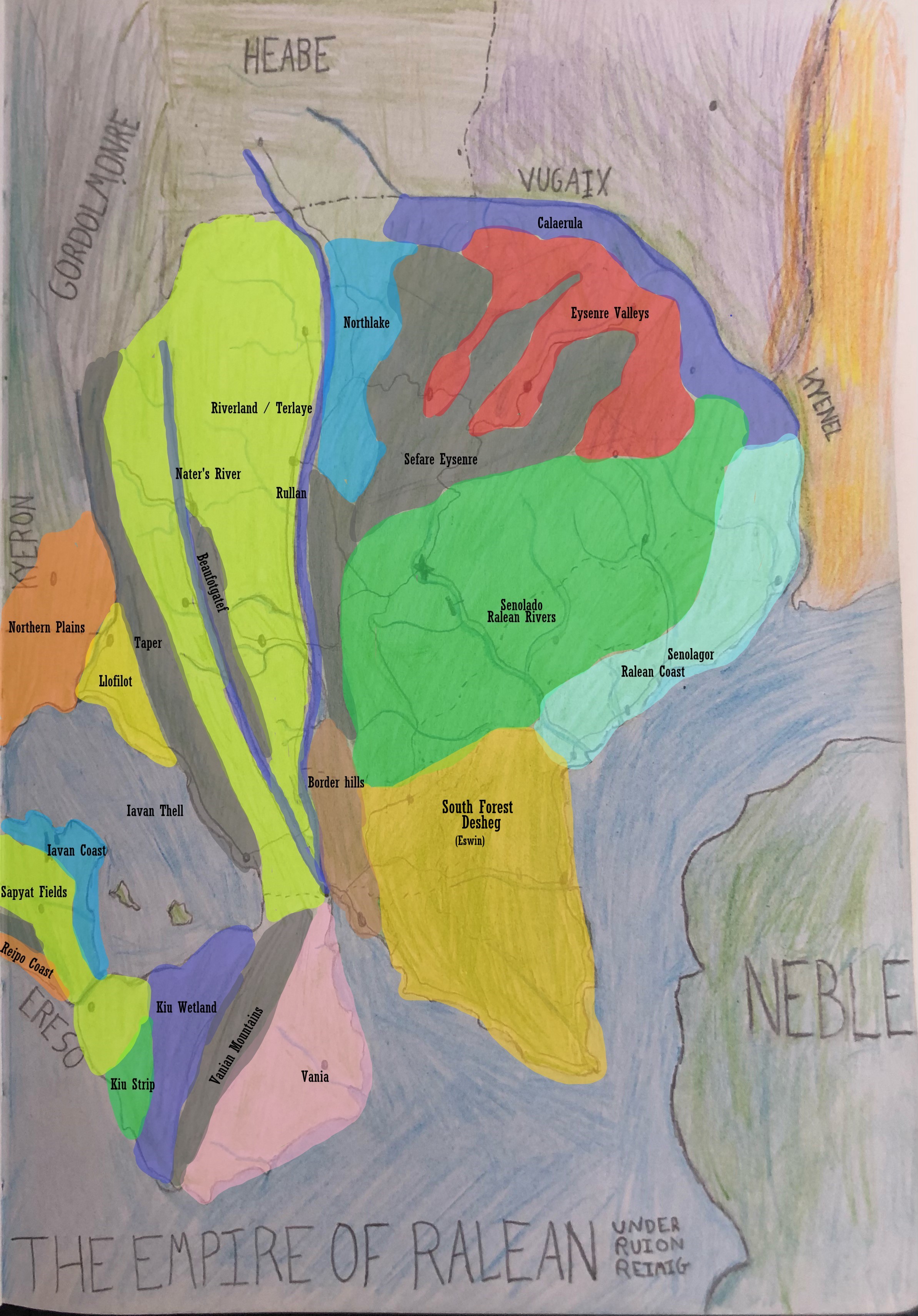
Regions
Senolado
Senolado holds over 60% of the region’s population. It is fertile, full of rolling hills and steady rivers, and highly developed. Senolado is very agriculturally productive. The region is well managed and highly deforested. It’s covered in well managed farmland, forestry, and plentiful pastures.
Ralean’s winter is its wet season, the ground is a vibrant green (mostly due to crops rather than wild grass). During summer, the grass turns a vibrant orange. The autumn and spring seasons are transitionary, spring seeing peak growth with wet grounds and plentiful sun while autumn’s a ripe season for harvesting as plants bloom.
Its staple crops are wheat, barley, and chickpeas. Sown during autumn/winder and harvested at the start of summer. Chickpeas are a more local plant. Sorghum and millet are other important grains and are often more prominent than wheat strains.
Olives, grapes, pomegranate, pistachio, and figs are the main orchard fruits. They are often ripe during the autumn.
Common spices are cumin, fenugreek, coriander, ossame, tumeric, ginger, tamarind, and moringa.
Cash crops are indigo, sesame, and kenaf.
On riverbeds, gourds, leafy vegetables, and onions are grown alongside some cottons.
Senolagor as a coastal region grows grows sugarcane, and coconut.
Most buildings are quarried red-grey limestone filled in with similarly coloured ground clay. Almost every building is covered in painted plaster. Rich areas will have artisan painted walls, while poorer areas will be covered in street art (which is often as beautiful if a different taste). Specially shaped raw rock pieces are often transported for wealthier-looking sturdy archways which are often chiselled with unique shapes. In poorer areas, chisselled bricks are still common if more amateruish.
On richer or more imposing buildings, tiles are often used on the exterior with artistic patterns.
Wind towers are prominent features on larger buildings. Following the design style of an architect prominent on the Empire’s foundation, these wind towers are often hexagonal. This architecture picked up strongly in their castles, clearly inspired by some silver ruins not found in Ralean but known for their sturdiness. The hexagonal features of the wind towers rarely imprint on the rest of the architecture.
Cities and towns are often dense and tall, split into blocks. Inside blocks, streets are often narrow with hanging flora. Between blocks are the traditional streets, often lined with three-storey tall sun-blockers (which may not have buildings behind them) which often prop up tarp to cover the equitorial sun. Streets never run east / west, with the exception of those covered year-round
Irrigation is everywhere. Upland and usually before cities there are large reservoirs of water designed to carry cities through the summer. Aqueducts are common and historical constructions. Within cities, water towers are literal tower constructions built from rock and clay designed to hold water and in many cases provide a basic water pressure for fountains. Alongside the water network of cities is often a well-designed sewer network that funnels city waste into proper management pools down-land, where waste is often dried and used as fertiliser.
The canal network is fairly new, providing narrow lateral waterway connections between the highly navigable rivers. Locks too are a good reason why these rivers are so navigable nowadays, with planned weir and locks in strategic locations to slow down flow for critical sections.
Sefare Eysenre
Sefare Eysenre are a large series of mountains with average peaks at about 2400m in height.
The Eysenre Valleys are large flatland valleys between Sefare Eysenre ridges.
Calaerula is the name of the very long river that starts in the Heabe that separates Ralean from Vugaix and Sarel. Either side of the river is a very liveable Greenland. This Greenland isn’t just on the southern side on Ralean, but also on the northern side in the Vugaix and in Kyenel. These greenlands not in Ralean sometimes have little villages on them too. These villages are counted to be part of Ralean even if they are in the region of the Vugaix or Kyenel. This is because they would steal the title of ‘only muz settlement in the Vugaix’ away from Nasarch.
The northlake region is east of the Sefare Eysenre mountains, and describes the harsh sloped land that eventually reaches the many lakes made by the slow moving Rullan. It is a dangerous ingredient climate, especially considering its proximity to the Heabe.
Desheg
The southern forest Desheg covers almost the entire south, with the Border Hills covering the remainder. It’s relatively undeveloped, with few roads and towns. It is also the home of an Ews faction known as Eswin
Border Hills includes all hills that border Terlaye in Ralean. They are relatively small but historically have acted as a good defensive barrier.
Fauna
Character Animal: Kite
The Kite is Ralean’s character animal. It’s been adopted by the Empire of Ralean to symbolise the Emperor’s hegemony and attempts to invoke an idea of the Empire’s omniscience. The particular species endemic to Ralean is similar to the Brahminy Kite. It is considered rude to include the kite directly on any emblems, but many emblems particularly those from the north use elements of its design.
Historic Name
In the modern world, Ralean is almost always called Ralean. There is another name that is significantly older than this still in use by some communities, “Aperolldor”. This name dates back to ancient times, around Techia times. It comes from a shortening of “Apaerula Goll Dorhui” which translates to “Past the West River”, where the west river refers to Rullan. This name is also used by some Terlayans and historically has been the Terlayan exonym for the place.
Name origin
The land of Ralean is based on Kithral Ya lands in DeMoch. Unlike the Kaemuz, Ximuz, Domuz, and Danmuz, the naming of the native Muz to this region (Lemuz) seems to be somewhat arbitrary when compared to its real-world inspired counterparts. As for the name of the region, Daklyn morphed “Yarile” into “Ralean” somehow.