- Barogate
- Ereso
- Terlaye
- Ralean
- Sarel
- Kyeron
- Gazi Lale Darie
- Gordolmonre
- The Heabe
- Dithas
- Vugaix
- Duela
- Kyenel
- Kusao
- Cronar
- Ichmenre
- Llyhai
Acvidaras
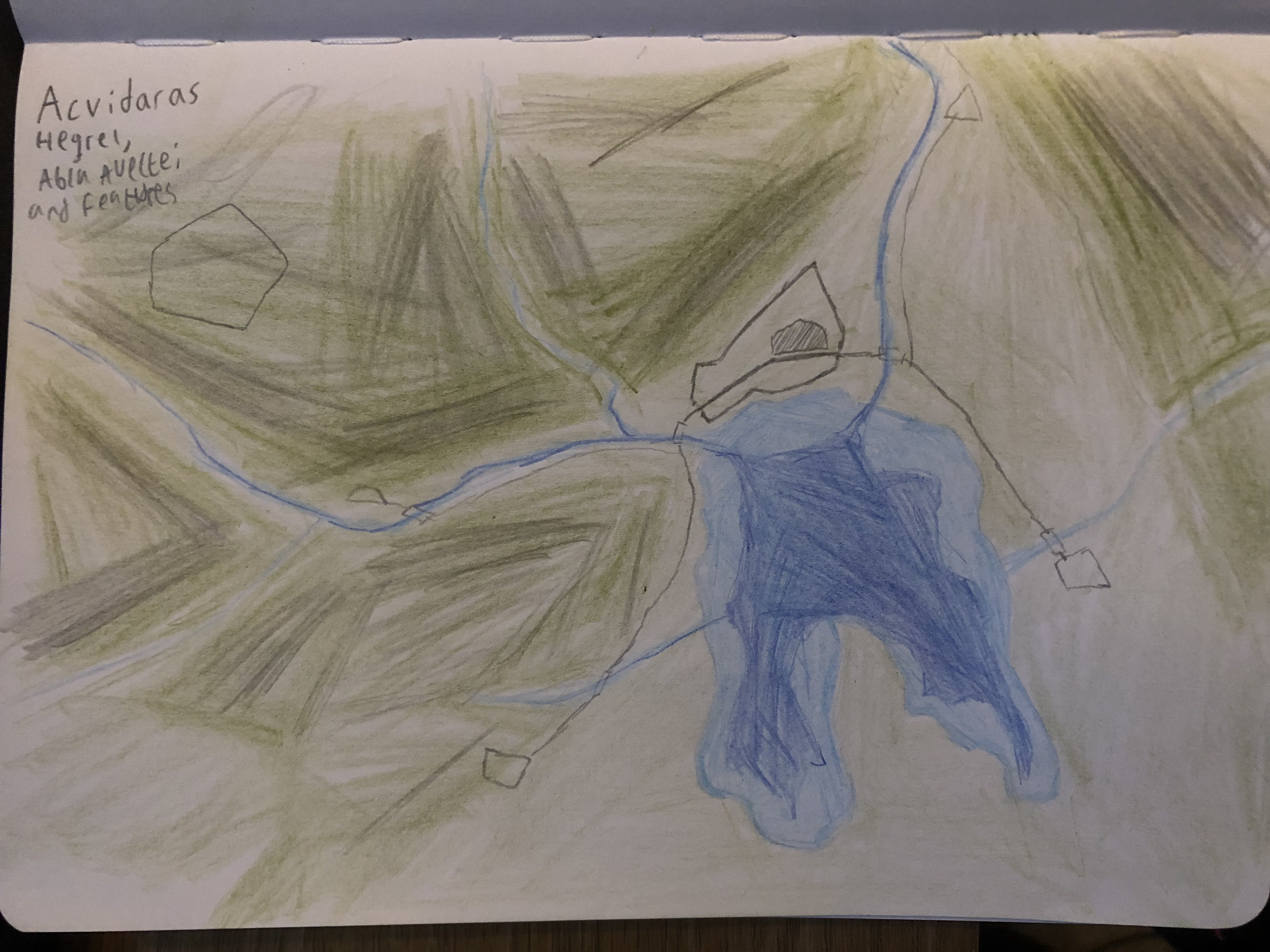
Acvidaras is the name of a small region in The Heabe with crossover with Gordolmonre most notable for the lake Abla Acvitei and Hegrel and all of its surrounding landmarks. There are not many places in the Heabe as dense as Acvidaras, as it has four towns, a city, and an ancient ruin all within walking distance of each other.
Physical Features
Acvidaras’ existance highlights the arbitrary borders regions convey. It, while recognised as a subregion of the Heabe due to the majority of its features existing within the Basinal Highland, has parts of its recognised region in Gordolmonre. These two “halves” require distinction because of their economic and geographical difference.
The Abla Acvitei lake is the most important feature of Acvidaras. It provides a year-round supply of water to the population and plays an important role in local culture and recreation. West of this Acvidaras’ cut of Gordolmonre. In this part there is one town, one bridge, and the prehistoric ruin of Gatesweep.
Only small parts of the land is fertile, particularly around rivers. Modern irrigation has made these regions suitable for growth year-round. Regardless of irrigation, trees struggle to grow in the region. there were originally none in the region, but it is told that the forestry here in the modern age are children of the original seeds that the founder of the city, Hegrel herself, brought to the region.
The origin of the name of the prehistoric ruin comes form an old tale reffering to the first explorers of the region. While approaching a door, one explorer tripped on a silver thing that stuck slightly out of the ground. One of their friends exclaimed “Ha! The Gate Sweeped them from his feet!”. Then the name stuck. From the outside, it is like any other silver ruin. Tall hexagonal metallic buildings jut out of the dirt, very few having doors and many having empty windows.
Dangers
Acvidaras is not a safe place. Although present everywhere, the Yulaesin and Yulachea are particularly present in the region especially when the water level is low. There are also unique Dkenf in the region.
There’s also a good population of Lindi living in the area, plain and simple. There’s a lot of the larger Arlind too, and they often go hand in hand. Around the area are plenty of the underground Neolithic-style complexes, the most famous one being on the little river peninsula. Hegrel has guaranteed that all of the lands of the peninsula are the Lindis to farm and hunt on. There’s about one other settlement like this nearby that gets the same privileges for the land they’re around. There are, however, annoying Lindi settlements that remain hostile to Hegrel attacking a few people. They are usually further in the mountains or further south.
There are very infrequent raider bands that have come to Hegrel a few times in the past. Hegrel remains fine and well-defended every raid, it’s the smaller towns outside that often get burnt and raided. Hegrel doesn’t have a military force, but does have a large army of guards and a few outpost towers that watch the area for anything entering, be it a raiding group or a Yula.
Town Names
- Hegrel, the big centre one
- Mihu Quarry Town, Quarry town, Mihu Quarry, or just Mihu
- Kentown, Ken Industry, Kenten
- Seasig, Rich Town
- Hill City, Hill Town, Reyten
- Ancient Ruins, Ancient Silver Ruins, Gatesweep
Acvidaras
There are two main parts to the Acvidaras area. The first is the flat land that Hegrel and its towns sit on. This flat bit is part of the basinal highlands of the Heabe, and its northmost lake is the lake which Acvidaras focusses on. The lake is called Abla Acevtei, but it is also often refferred to as “Lake Acvidaras”. West of this area is a more mountainous region that is more officially part of Gordolmonre. The most important parts of this western mountain land is River, the town, and also access to the silver ruin of gorgolmonre.
Not all of the land is fertile. That which is gets used in the crop-farms, and that which isn’t is used to grow sheep. There sits a massive quarry in the mountains that, as discussed in history, provides the region with its entirely stone infrastructure. There are not many trees in the region. There were none here originally, and those that are there stem from the old lineage of seeds that Hegrel herself brought to the region. Trees don’t naturally grow well, so the small forest, situated on a slope on the road from Hegrel to Mihu Quarry Town. Each tree is carefully tended to by wizards, who use their magic to grow the trees for whatever limited use they have.
Around the area are 5 bridges. These bridges serve as a crossing point between the region’s many towns, but are not as important during winter where the rivers run dry and you can just walk across anyway. Many of these bridges are situated along the only road in the region.
To the west, the flatlands become very much not flatlands. They become dramatic mountains, that rise harshly and smoothen near the top. On the top of one of these mountains are the ancient silver ruins, dubbed by the locals as Gatesweep. This name comes from the mundane story of the first explorers of the ruins. While approaching a door, one explorer tripped on a silver thing that stuck slightly out of the ground. One of their friends exclaimed “Ha! The Gate Sweeped them from his feet!”. Then the name stuck. From the outside, it is like any other silver ruin. Tall hexagonal metallic buildings jut out of the dirt, very few having doors and many having empty windows.
Dangers
If you’re on the website, this used to be in the heabe region document. I just copy-pasted it here, I haven’t merged it properly.
Acvidaras is actually subject to many different dangers throughout the year. These dangers are persistent or new. Firstly, the wetlands where the lake recedes during the winter. It’s not too common, but every now and then a monster or two appears on this wet land. It doesn’t stray too far out, and during the early days of Hegrel they weren’t as much of a problem. Now, however, there are more ground disturbances and more of the monsters rise. They are part of the reason it’s dangerous to travel in Acvidaras during winter. Caravans are usually well equipped to deal with the monsters though. Traders will ditch the cart and let the Guards take them down, either with pikes or ranged weapons.
Wandering not only in this region but the entirety of the Heabe is the Yulachi, or just Yulachela in full. These beings are crab-like creatures with flat bodies, four girthy legs, an exoskeleton, and a single head with a horrible mouth with shark-like teeth. The mouth itself almost splits in two for the giant jaw. Although that is the general Yulachi, the ones of the Steppe often have thinner shells of greener colour. The Yulachi are an infrequent hazard, but still present. Their attacks are regular but devastating, they use their massive and powerful jaw to bite with, and their legs to bash and stomp.
There’s another creature which is another type of the Yulachi, but is often called the Yulasin, or Yulaesina in full. It is almost identical to the Yulachi, but with a single additional feature that is two extra limbs extending from their backs. These have four segments. The first three are all the same length, and are simple chitinous limbs with dextrous joints that only bend forwards. The last segment is a thick and sharp spike which the Yulasin uses to impale its pray. This version of the Yula is a lot more successful than the Yulachi in killing things.
One thing about the Yula species is that they can’t survive upside down. If you manage to flip a Yula over, which is a incredibly difficult action due to how wide and heavy they are, they just die as liquids can’t pour to the important parts of their body. They are not designed to be upside down, and even if they could survive it there is no way the Yula could flip themselves over again. This is partly why one of the most iconic defences in regions in danger of the Yula have steep slopes on their palisades and walls.
Another one of the Waste’s creatures also reside in the Heabe, and are almost exclusive to it. The Dkenf are a bat-like species that fly high altitudes. They are much larger than any bat, being about the size of a person. There also exists a few gargantuan Dkenf, called Dkenfaur. These are really big, about half the size of Lovyns.
There’s also a good population of Lindi living in the area, plain and simple. There’s a lot of the larger Arlind too, and they often go hand in hand. Around the area are plenty of the underground Neolithic-style complexes, the most famous one being on the little river peninsula. Hegrel has guaranteed that all of the lands of the peninsula are the Lindis to farm and hunt on. There’s about one other settlement like this nearby that gets the same privileges for the land they’re around. There are, however, annoying Lindi settlements that remain hostile to Hegrel attacking a few people. They are usually further in the mountains or further south.
There are very infrequent raider bands that have come to Hegrel a few times in the past. Hegrel remains fine and well-defended every raid, it’s the smaller towns outside that often get burnt and raided. Hegrel doesn’t have a military force, but does have a large army of guards and a few outpost towers that watch the area for anything entering, be it a raiding group or a Yula.